· Derek Malone
Ropeless vs Weighted Jump Rope: What You Lose Without the Rope
Weighted handles with no cable attached are a clever answer to a real problem. Low ceiling, thin floor, hotel room, a rope that keeps finding the light fitting — all of it disappears the moment nothing is swinging under your feet. The question is what disappears with it, because the cable is not a delivery mechanism for the weight. It does several jobs at once, and most of them are invisible until it is gone.
What "ropeless" means, mechanically
A ropeless setup is a pair of handles, usually weighted, sometimes with a short stub of cable or a small ball on the end to give the wrist something to turn against. You hold them, turn them as though a rope were attached, and jump on your own count. Some versions add a counter that reads wrist rotation and calls it a rep.
Everything above the wrists is close to a normal session. Everything below them is a different activity: nothing travels under your feet, so the jump is no longer timed by an object arriving — it is timed by you deciding to leave the ground. That single change is where every difference below comes from, and the phrase "ropeless jump rope" hides it by making the two sound like variants of one thing.
The cable is what decides when you jump
Jumping rope is not a jumping exercise with a rope added for style. The cable arrives at your feet at a moment determined by how fast you turned it, and you leave the ground because it is arriving. Your legs answer an external cue, hundreds of times, at a cadence your wrists set. That relationship is the skill, and it is why rope work transfers to sports where footwork has to obey something outside your own head.
Take the cable away and both halves of that loop become internal. Your wrists turn at whatever speed feels right, your legs jump at whatever moment feels right, and nothing arbitrates between them. In practice the two drift apart within a couple of minutes: the hands speed up, the feet settle into a comfortable bounce, and you end up doing two exercises at once rather than one coordinated one. It still costs you effort. It stops being rope work.
A miss is information, and ropeless never gives you one
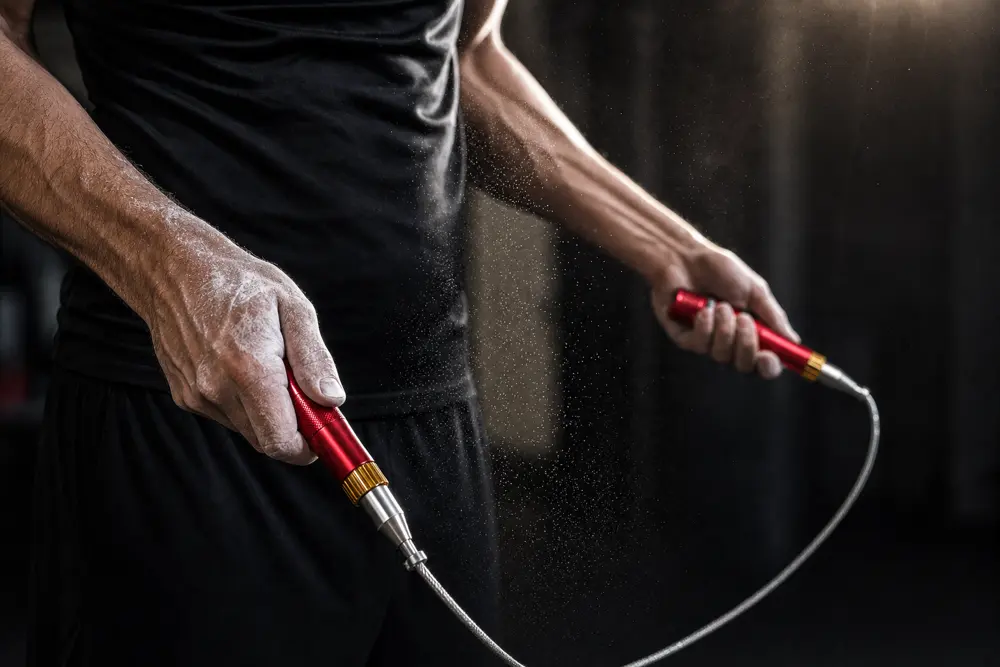
Catching the cable on your toes is the most useful feedback in the whole exercise. It is instant, unambiguous, and it names the thing that slipped — you jumped early, you jumped late, your elbows drifted out and shortened the arc, or your hands dropped below the point where the cable clears. Nobody has to coach it. The rope files the report the moment the error happens, which is why people learn to jump rope without ever being taught.
A ropeless set cannot produce that signal, because there is nothing to catch. Every rep is a clean rep by definition. That sounds like a feature, and for a beginner who finds constant misses discouraging it genuinely is one, for a session or two. Past that it becomes a problem: form degrades quietly with fatigue, and the setup keeps reporting success. The counter reads wrist turns whether or not your feet had anything to do with them.
Someone new to rope work is exactly the person whose technique is still forming, and technique forms against feedback. Our beginner's guide is built around that — the first two weeks let the cable teach the timing before any resistance goes near it.
Where the resistance actually comes from
Both setups load your arms, and they do it from different places. On a ropeless set the mass sits in your hands. You rotate a weight around your wrist joint, which is real work for the forearms and shoulders and feels like it from the first minute. What you do not get is any pull from further out. On a cabled rope the cable is mass travelling in a wide circle around you, hanging on the handle through the whole rotation — the load arrives at the end of every turn, pulling outward, and your grip and shoulders answer it each time. That outward tug is what people mean when they say a weighted rope fatigues the upper body differently from dumbbell work.
The Ironpace rope splits this deliberately: a removable weight insert inside each handle, and two cables of different thickness in the case. Those are two resistance systems, dialled independently. Handle weight in with the thin cable gives you load at the wrist and speed through the turn; weight out with the thick cable moves the resistance out into the swing. Which combination does what is laid out in our guide to choosing your cable. A ropeless set offers only the first half, because the second half needs a cable to exist.
Side by side: what you keep, what you trade
| What you are after | Ropeless handles | Weighted rope |
|---|---|---|
| Overhead clearance needed | None | Arm's reach above your head |
| Noise from the session | Landings only | Landings, plus the cable on the floor |
| Timing cue for the jump | You supply it | The cable supplies it |
| Error feedback | None — every rep counts as clean | Immediate, on the rep that went wrong |
| Where the load sits | In the handles | Handles and the whole rotating cable |
| Rope skills (double unders, crossovers) | Not available | The reason they exist |
| Packs into a bag | Yes | Yes, in the carry case |
What going ropeless genuinely solves
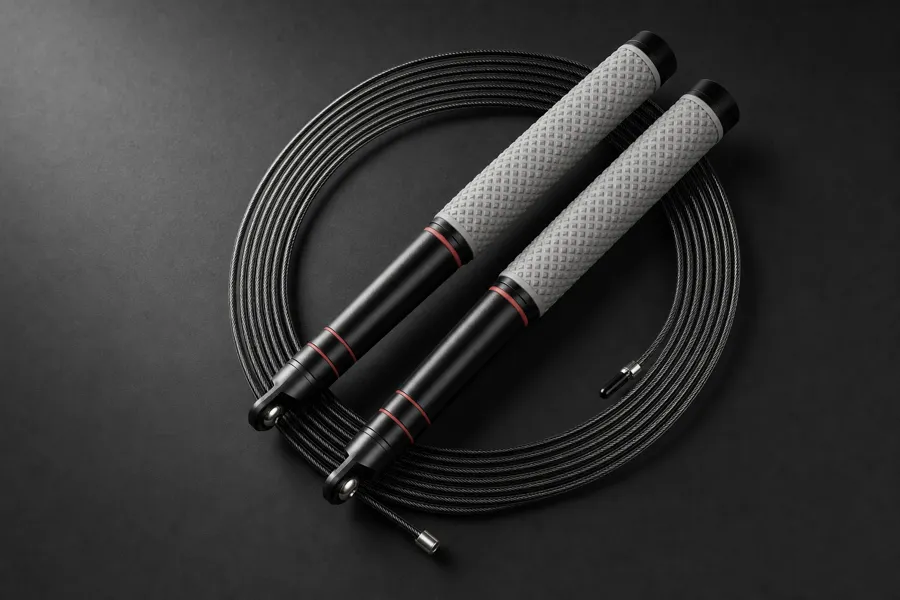
Three constraints are real. A basement with exposed joists or a room with a low light fitting will not accept a cable, full stop. A flat above a neighbour who works nights caps how much floor noise is reasonable. And a suitcase week with an unknown room at the other end is easier without a cable to place.
Two of the three usually turn out smaller than they look once measured rather than assumed. Overhead room is settled in five seconds by standing where you plan to train and raising one arm, and most floor noise comes from your landings rather than the cable, so a mat and softer landings do most of the work. The surfaces, the space check and the quiet-landing technique are laid out in our guide on where to use a weighted jump rope — run those checks before concluding the room is closed to you.
Travel is the one that stays true. A cable needs somewhere to go, and a hotel room between the bed and the wardrobe is not that place. If you already own a set of handles, that is the week they earn their keep. What those sessions deliver is arm and cardio work holding the habit together — the timing comes back on the cable when you are home.
The skills that only exist on a cable
Some of rope training is not reproducible without a rope, by definition rather than by degree. A double under is the cable passing under your feet twice on one jump. A crossover is the cable crossing in front of your shins while you clear it. A side swing is the cable travelling beside your body instead of under it. Every one of those is a statement about where the cable is — the arm motion can be mimed, but the skill is the timing, and the timing is the cable.
That is what boxers are training in a rope round: footwork patterns and rhythm changes built on an object arriving at a fixed interval. For the hardest of those skills and which of our four setups carries it, our guide on double unders with a weighted rope goes through it setup by setup. And if the real question is which style of cable to run rather than whether to run one at all, the weighted versus speed rope comparison is the one to read next.
How the Dual Cable System answers the same constraints
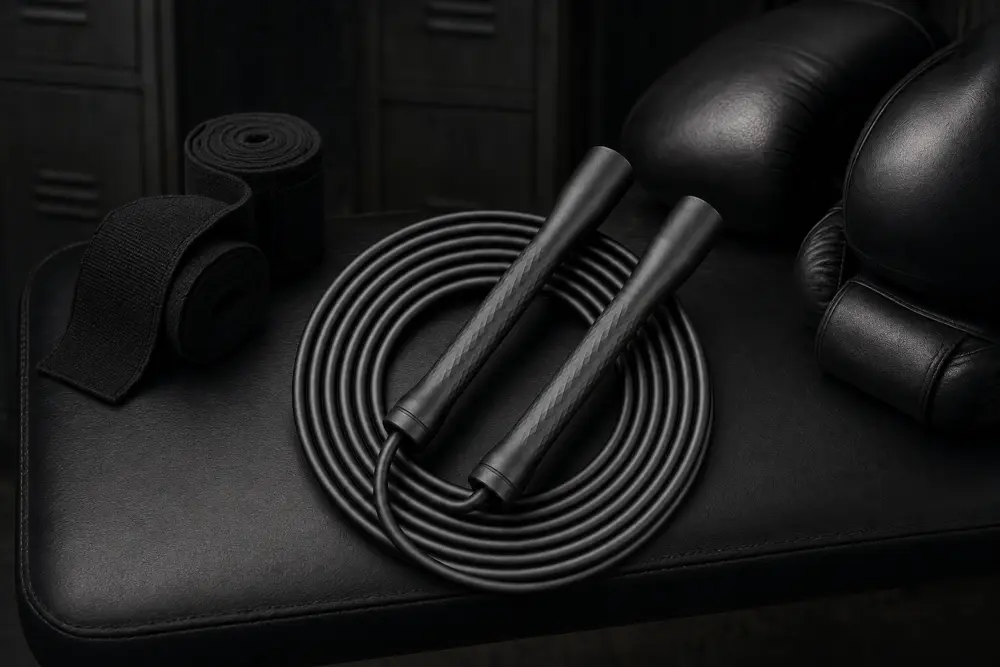
The reason a ropeless set looks appealing is almost always adjustability: one purchase that behaves differently depending on the day. That is the problem the Ironpace Dual Cable System is built around, and it solves it without giving up the cable — two cables, a weight insert that comes out of each handle, and four combinations from one pair of handles at one price.
The lightest of the four is the thin cable with the inserts removed, and it is the one to reach for when the room is tight, the floor is thin or the session is technique rather than conditioning. The heaviest is the thick cable with the weight in, a conditioning tool for short rounds. Both run on the same sealed ball bearing, the part that decides whether the cable keeps a clean rhythm or snatches at your wrist mid-set, and both travel in the carry case along with any weight pulled out of the handles — the whole system packs down without knotting through a gym bag.
What the specification sheet describes is the system rather than a gram figure: two cables of different thickness, and an insert that comes out of each handle. If an exact number matters for your training log, get in touch before ordering and we will look into it for you.
Verified feedback keeps landing on the swap rather than the weight. One buyer wrote: "Solid build, and swapping between the thin and thick cable takes seconds. My only note is the thicker cable takes a session or two to get the timing right if you are used to a lighter rope." Another put the adjustability plainly: the "additional weight inside the handle can be removed. Perfect for training." And on the part that decides whether the rhythm holds: "Bearing rotation is excellent, no snag and no catch, even after a few weeks of daily footwork drills."
Cable and handle-weight combinations the Dual Cable System allows
— Ironpace product specification, 2026
Verified buyer reviews on file for this rope
— Ironpace order history, 2026
Average rating across those verified purchases
— Ironpace verified buyer feedback, 2026
Units sold to date
— Ironpace sales data, 2026
Full write-ups, including the four-star notes, are on our reviews page. The rest of our training guides are in the guides index.
The choice comes down to what you want the session to build. If the answer includes timing, footwork, or any skill defined by where a cable is, the cable is not the accessory — it is the exercise, and the resistance is what gets added to it. The Ironpace rope is $49.95, down from $69.99, with free shipping in 6 to 10 business days and a 30-day money-back guarantee under our refund policy. Black, Silver or White, chosen at checkout.
Ropeless versus weighted rope FAQ
Is a ropeless jump rope as good as a real weighted rope?
They train different things. Weighted handles turned in the air give you arm and shoulder work with no clearance needed. A cable adds the part handles cannot reproduce: it passes under your feet, so it sets the timing of every jump and tells you immediately when your rhythm slipped. If rope skill is part of the goal, the cable does the teaching.
Do ropeless jump ropes give you the same workout?
The arm and cardio effort can get close, because you are still turning a mass and still jumping. What changes is precision. Without a cable there is nothing to clear, so jump height, wrist path and cadence all drift toward whatever feels comfortable, and comfortable is rarely what you set out to train.
What can you do with a cable that you cannot do ropeless?
Anything where the cable is the point: double unders, crossovers, side swings, and the timing drills boxers build footwork on. Those are all defined by where the cable is relative to your feet, so there is nothing to time without one.
Is the Ironpace rope adjustable enough for small spaces?
It runs four configurations from the same pair of handles: thin or thick cable, weight insert in or out. The thin cable with the weight removed is the lightest and quietest of the four, and it is the setup we point people toward when the room is tight or the session is a technique block.

Derek Malone · Strength coach & product lead at Ironpace
Derek has coached boxing and CrossFit conditioning for over a decade.