Weighted Jump Rope for Beginners: How to Start Without Fighting the Cable
A weighted jump rope is not a heavier version of the speed rope you used in gym class — it moves differently, and treating it the same way is how beginners end up sore, frustrated, or nursing a wrist strain by day three. This guide covers what actually changes when you switch to a weighted rope, the mistakes we see most often from first-timers, and how to use a removable-weight design like the Ironpace Dual Cable System to build up gradually instead of guessing.
🚨 Only a few left in stock
Weighted rope vs. speed rope: why the first session feels different
A plastic speed rope is built to be forgiving. It is light enough that a slightly late or early jump barely matters — the rope simply doesn't carry enough force to disrupt your rhythm. A weighted rope flips that. The cable and handles carry real momentum through each rotation, so the margin for error at your feet is smaller. That is not a flaw in the product; it is exactly why coaches use weighted ropes for conditioning — the added resistance forces your shoulders, forearms, and footwork to work harder on every single rep.
The problem is that most beginners don't know this going in. They pick up a weighted rope expecting the same forgiving feel as the rope they used as a kid, load the heaviest cable and full handle weight on the first try, and end up chasing a rope that keeps clipping their ankles. That first bad session is usually a setup problem, not a skill problem — and it is fixable in the first ten minutes if you start lighter than you think you need to.
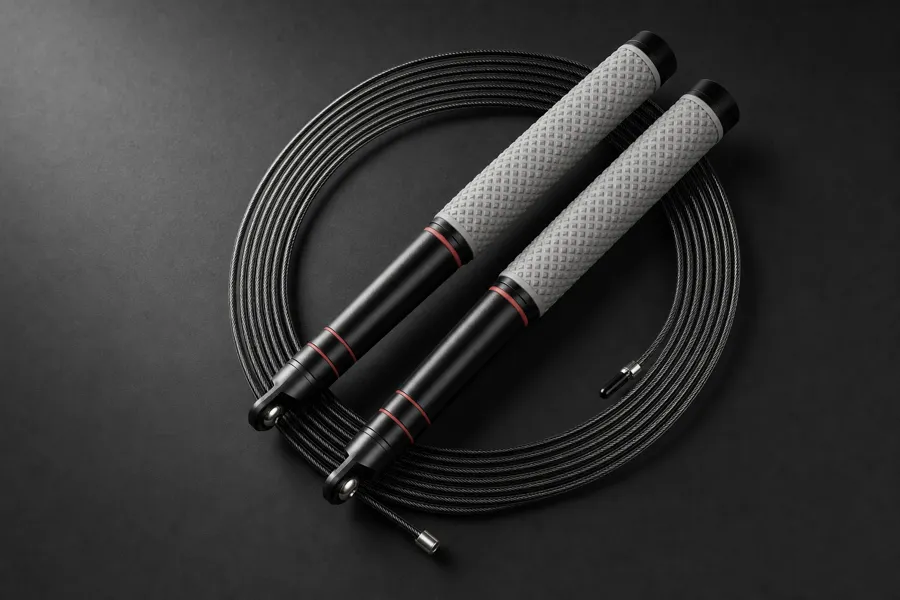
The handles are the adjustment point: removable internal weight lets a beginner train lighter before working up to the full setup.
How to start: your first two weeks with a weighted rope
The goal of your first sessions is to teach your wrists and feet the new rhythm, not to prove you can handle the heaviest configuration in the box. A sensible progression looks like this:
| Stage | Setup | Session shape |
|---|---|---|
| Days 1-4 | Thin cable, handle weight removed | 3 rounds × 60 sec, rest 60-90 sec between rounds |
| Days 5-10 | Thin cable, handle weight removed | 4-5 rounds × 90 sec, rest 45-60 sec between rounds |
| Days 11-14 | Reinsert handle weight, keep thin cable | 4 rounds × 90 sec, focus on clean footwork over speed |
| Week 3+ | Full handle weight, switch to thick cable | Build back up from short rounds at the new resistance |
This is a general starting framework, not a medical or training prescription — adjust pace to how your wrists and calves respond.
Common beginner mistakes with a weighted jump rope
Going full weight on day one. This is the single biggest one. The thicker cable plus a fully loaded handle is meant for someone who has already built rope timing on a lighter setup — not a starting point.
Jumping too high. Beginners often over-jump to "make sure" the rope clears, which throws off landing timing and tires the calves fast. A weighted rope needs barely more clearance than a speed rope — an inch or two off the ground is enough.
Gripping the handles too tight. A death-grip fights the rope's natural swing and transfers fatigue straight into the forearms. The ball-bearing swivel in the handle is there to let the cable rotate freely — let it do that work instead of muscling it.
No rest days. The added resistance means more load on the wrists and forearms per rep than a speed rope. Beginners who jump every single day tend to hit a wall around week two; spacing sessions with at least one rest day lets the connective tissue catch up.
Why heavier isn't always better when you're starting out
There's a common assumption that if a little resistance is good, a lot must be better, faster. With a weighted jump rope, that logic breaks down quickly. The rope's resistance shows up in your shoulders and wrists on every rotation — hundreds of times per session. If your form is off even slightly, going heavier doesn't just make the workout harder, it repeats the flaw more times per minute. That's how beginners end up with wrist soreness that has nothing to do with actual conditioning progress and everything to do with an avoidable setup choice.
Buyers who leave feedback after switching from a lighter rope consistently point to the same thing: the cables that ship with a serious weighted rope are noticeably heavier than a standard speed rope, and that difference is the training stimulus — not something to rush past. Respecting that is what separates a rope that becomes a regular part of a boxing or CrossFit warm-up from one that gets shelved after a rough first week.
Removable weight: the feature that makes beginner-friendly progression possible
This is the practical difference between a weighted rope built for a training progression and one built as a single fixed product. Instead of buying a light rope, outgrowing it, and buying a heavier one later, a beginner can start with the weight removed and the thin cable installed, then add each variable back one at a time as timing and grip strength improve. It also means the same rope keeps being useful long after the beginner phase — advanced users run the full handle weight with the thicker cable for the added resistance, while a partner or training log at a different stage can drop straight back down.
Reviewers who bought the rope specifically to swap between configurations describe exactly this: the weight insert comes out cleanly, both cables attach the same way, and the swap takes under a minute — no tools, no separate purchase required to change the resistance level.
By the numbers
Average rating across all verified buyer feedback
— Ironpace verified order history, 2026
Verified buyer reviews on record for the Dual Cable System
— Ironpace verified order history, 2026
Units sold to date, including first-time weighted-rope buyers
— Ironpace sales data, 2026
A realistic starting point, not a race
None of this is about being cautious for its own sake — it's about not wasting your first month fighting equipment instead of building the skill. A weighted jump rope earns its place in a boxing or CrossFit warm-up because the resistance is real, and real resistance rewards patience more than it rewards ambition on day one. Start light, remove the handle weight if your rope has that option, keep sessions short, and let the setup grow with your technique. For the broader case on why the added resistance is worth building toward, see our page on using a weighted jump rope for weight loss.
If you want to see how other first-time buyers describe their own break-in period, our reviews page has feedback from verified purchases, including a few buyers who specifically mention starting with the weight removed. You can also read more training context in our weighted vs. speed rope breakdown and our beginner-friendly workout routines on the blog.
Free shipping · 30-day money-back guarantee

Derek Malone · Strength coach & product lead at Ironpace
Derek has coached boxing and CrossFit conditioning for over a decade.
Reviewed and updated July 5, 2026. Questions about your order? Contact us — see our shipping and refund policy for details.
Beginner FAQ
Is a weighted jump rope hard to use for beginners?
It's harder than a plastic speed rope at first because the cable and handles carry real momentum, so your timing has to be cleaner. Most beginners adjust within a week if they start with the lighter cable, remove the internal handle weight, and keep sessions short before adding load back in.
Should a beginner remove the weight from the handles?
Yes, if the model allows it. Ironpace's handles have a removable internal weight, so a beginner can train with lighter handles and the thinner cable first, then reinsert the weight and switch to the thicker cable once footwork and timing feel automatic.
How long should a beginner jump rope session be?
Short. Three to five rounds of 60-90 seconds with rest between them is a realistic starting point. Total working time under 10 minutes is plenty while you are still learning to read the rope and control the handles.
What is the biggest mistake beginners make with a weighted jump rope?
Starting with the heaviest cable and full handle weight on day one. It slows the swing down more than expected, wrecks wrist timing, and turns the first session into a fight instead of a skill-building rep. Build up in stages instead.