· Derek Malone
Weighted Jump Rope vs Running: Calories, Joints and Time
Most people who ask this question already own running shoes. What they want to know is whether ten or fifteen minutes with a rope buys them anything a run does not, and whether the trade goes the other way when time is short. The two are closer than the gym-versus-road framing suggests — both are rhythmic, both are mostly legs and lungs — and the differences that matter are specific: where the work lands in the body, what each landing asks of your joints, and how much of your day a session actually takes.
Two ways to spend the same fifteen minutes
Running is a locomotion exercise: you carry your body weight forward, one leg at a time, and the pace sets the cost. Rope jumping is a stationary one: you leave the ground on both feet on a cue set by the cable, and the cadence of your wrists sets the cost. Put a weighted cable and weighted handles into that second picture and a third thing changes — a share of the work moves out of the legs and into the shoulders, forearms and grip, because a heavier rope has to be turned, not flicked.
That is the whole comparison, and everything below is detail on it. Both raise the heart rate quickly. Where they part ways is the shape of the effort, the landing, and the logistics — the three things that decide which one you actually do on a Tuesday evening.
Calories: what the Compendium says, minute for minute
The one place we will put a number on this is the 2024 Adult Compendium of Physical Activities, the reference list researchers use to compare the energy cost of activities. It rates each activity in METs — one MET is the energy of sitting quietly, defined as 1 kcal per kilogram of body weight per hour — so the values compare activities against each other rather than promising a calorie figure for you.
Its rope entries are graded by cadence and its running entries by pace, and the table reads them across: a moderate rope cadence, 100 to 120 skips a minute on a two-foot bounce, sits where an 8-minute mile does, and an easy jog sits below a slow skip.
| Activity, as listed in the 2024 Compendium | METs |
|---|---|
| Rope jumping, slow pace, under 100 skips/min | 8.3 |
| Rope jumping, moderate pace, 100–120 skips/min | 11.8 |
| Rope jumping, fast pace, 120–160 skips/min | 12.3 |
| Rope jumping, double unders | 10.0 |
| Jogging, general, self-selected pace | 7.5 |
| Running, 12 min/mile (5 mph) | 8.5 |
| Running, 10 min/mile (6 mph) | 9.3 |
| Running, 8 min/mile (7.5 mph) | 11.8 |
Two cautions, both of them the Compendium's own. Those values describe a plain rope and a plain bounce; the Compendium has no entry for a weighted rope, so the added cable and handle load sits outside the table. And a MET is a rate, not a result: it says what a minute costs, not what a week does. If the reason you are comparing is a fat-loss plan, our weight-loss guide covers where a denser session fits in that plan.
Where the effort lands in the body
A run is legs, hips and lungs. The arms swing for balance and that is roughly the end of their involvement: the upper body finishes a run having done very little.
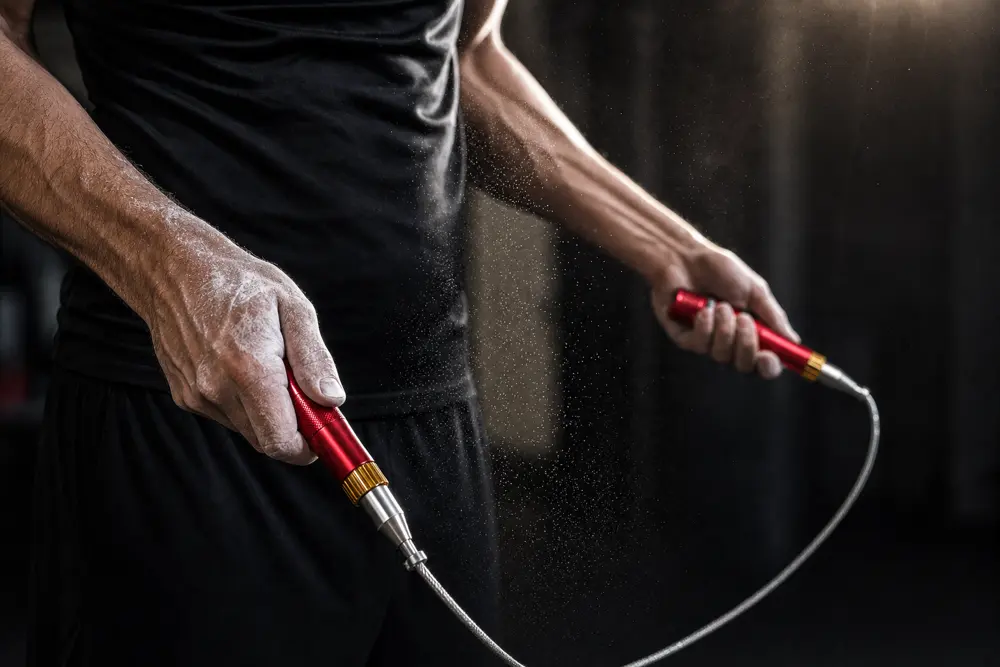
A weighted rope distributes the same minutes differently. The cable is mass travelling in a wide circle around you, and it hangs on the handle through every rotation, so the shoulders and forearms answer an outward pull several hundred times a round. The handle weight adds a second load right at the wrist. Our benefits guide goes through what that produces over a training block — grip and forearm endurance first, a slower and more controlled swing second — and it is the part of the comparison the Compendium cannot see, because it lists the bounce, not the load.
The practical consequence is that the rope tends to finish you from the top down. Runners who pick up a weighted cable for the first time are usually surprised that the forearms give out before the calves do — which is why the first two weeks belong on the lightest setup, the thin cable with the weight removed, while the wrists catch up.
Joints: one foot at a time, or two feet from an inch up
This is where most people expect a verdict, and the useful answer is a description. Running lands one leg at a time, with the whole body travelling forward over it, and the pace decides how hard that landing is. Rope jumping lands both feet together from a hop of an inch or two — the cable only needs that much clearance — on the balls of the feet, with the body staying in place. Each landing is shared across two legs, and the descent is short because the ascent was.
A weighted cable changes the rhythm of that. A heavier rope cannot be flicked, so the cadence drops and each jump becomes more deliberate: fewer landings per minute, each of them on a rope that told you exactly when to leave the ground. The surface underneath matters more once the rope is weighted, for the same reason — our guide on where to use a weighted jump rope ranks the floors, and a mat over hardwood or a rubber gym floor is the answer for your calves as much as for the cable.
What none of this is: a promise about your knees. How a particular joint responds to either depends on the person, the surface, the footwear and what that joint has been through. If a knee, ankle, Achilles or lower back is already sore, or you are coming back from an injury, check with a physiotherapist or doctor before starting either one — and when you do start, start short, on a mat, on the lightest of the four setups.
Time: the session starts when you pick up the handles
Here the two separate cleanly. A run has overhead: a route, a change of shoes and clothes, a walk to the start, a cool-down back, a shower that cannot wait. Thirty minutes of running is rarely thirty minutes of your day. A rope session has almost none of that. You stand on the spot you cleared, lift the handles off the hook, and the first round starts inside a minute.
That matters more than it sounds, because the thing that decides whether conditioning happens is not how effective the session is but how often it starts. The 10-minute interval starter in our routines guide is a complete session — warm-up, work rounds, rest, done — and it fits into gaps a run does not: before dinner, between two calls, while the kettle boils twice. Three or four of those a week are a training habit that survives a busy month.
Space, weather, and what a run needs that a rope does not
A run needs somewhere to go and weather you can go out in. A rope needs a patch of floor about the size of a doormat and enough headroom to raise one arm — stand where you plan to train and lift a hand; if there is daylight above your fingertips, the cable will clear.
Rain, dark evenings, ice, a hotel room, a garage in January: none of them cancel a rope session, and the case that holds both cables and the pulled weight inserts means the whole system travels in a gym bag. A run gives you distance, air and a route. The rope gives you the session that depends on none of those — the one you can always do, where you already are.
Side by side: run and weighted rope
| What you are comparing | A run | Weighted jump rope |
|---|---|---|
| Energy cost band (Compendium 2024) | 7.5 METs easy jog, 11.8 at 8 min/mile | 8.3 METs slow cadence, 12.3 fast — added load not listed |
| Where the work lands | Legs, hips, lungs | Legs and lungs, plus shoulders, forearms and grip |
| Landing pattern | One leg at a time, body moving forward | Both feet together, an inch or two, on the spot |
| What sets the cadence | Your pace | The cable — a heavier one slows it down |
| Space | A route | A doormat of floor and an arm's reach of headroom |
| Weather | Part of the plan | Not a factor indoors |
| From decision to first minute of work | Shoes, clothes, route, warm-up walk | Inside a minute |
| Built-in feedback | Pace and breath | A miss names the rep that slipped |
| Travels | In your shoes | Rope, both cables and inserts in one case |
How the Dual Cable System fits around a running week
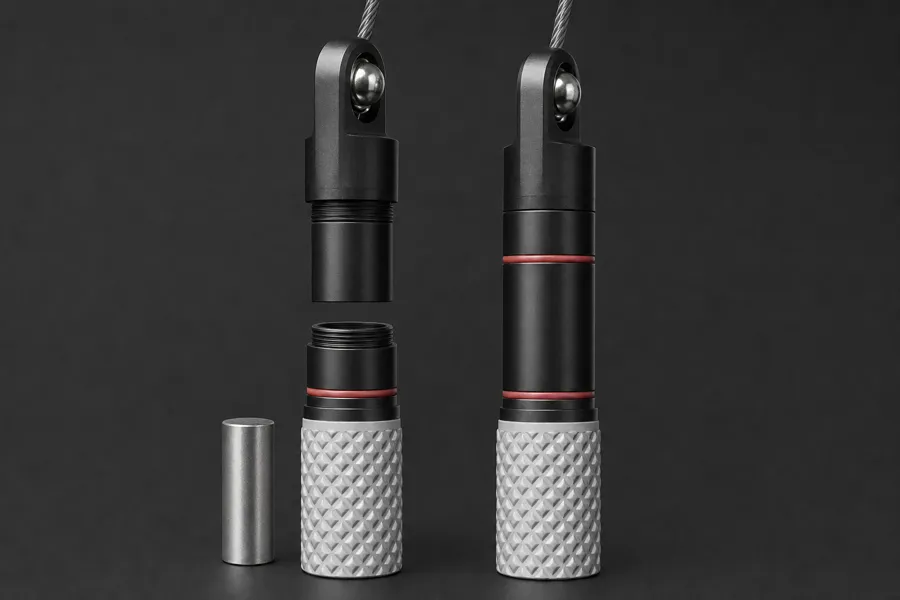
Most buyers who mention running are not choosing between the two: they run, and they want the days in between to count without another hour outdoors. The Ironpace Dual Cable System is built for exactly that kind of week, because it is four ropes in one pair of handles: thin or thick cable, weight insert in or out.
Thin cable, weight out, is the cadence tool — the lightest and quietest of the four, the setup for a five-minute rhythm warm-up before a run or a technique block on a day the legs need to move without load. Thick cable, weight in, is the conditioning tool for short rounds on a day off, when you want the shoulders and grip to do the work the run did not ask of them. Which combination suits which session is laid out in our guide to choosing your cable, and the swap itself takes seconds. One verified buyer put it that way — "swapping between the thin and thick cable takes seconds" — with the note that "the thicker cable takes a session or two to get the timing right if you are used to a lighter rope."
If the rope is new to you, the first fortnight is a timing block before it is a conditioning block — the beginner's guide is built around letting the cable teach the rhythm on the lightest setting before any weight goes back in. A coach who bought three for a class described the same progression: "you can pull the weight out of the handle for beginners and leave it in for the advanced group."
METs the Compendium assigns to moderate-pace rope jumping — the same value it gives running at 7.5 mph (8 min/mile)
— 2024 Adult Compendium of Physical Activities, Herrmann et al., J Sport Health Sci, 2024
Cable and handle-weight combinations the Dual Cable System allows
— Ironpace product specification, 2026
Verified buyer reviews on file for this rope
— Ironpace order history, 2026
Average rating across those verified purchases
— Ironpace verified buyer feedback, 2026
Units sold to date
— Ironpace sales data, 2026
The two sit in the same band on the one scale that rates them minute for minute, and differ in everything around that minute. What the rope does is put the session where you are — a doormat of floor, any weather, inside a minute of deciding — and spread the work across the shoulders and grip as well as the legs, on a cadence the cable sets and a heavier cable slows down. The Ironpace rope is $49.95, with free shipping and a 30-day money-back guarantee under our refund policy. Black, Silver or White, chosen at checkout.
Weighted jump rope versus running FAQ
Is jumping rope as good a workout as running?
On energy cost the two sit in the same band. The 2024 Adult Compendium of Physical Activities lists moderate-pace rope jumping at 11.8 METs, the same value it gives running at 7.5 mph. What separates them is where the work lands: a run loads the legs and lungs, a weighted rope adds the shoulders, forearms and grip on every turn of the cable.
Is a weighted jump rope easier on the knees than running?
It loads them differently. A run lands one leg at a time with your whole body moving forward. A rope lands both feet together from an inch or two off the ground, and a weighted cable slows the cadence so each landing is more deliberate. If a knee, ankle or Achilles is already sore, check with a physiotherapist or doctor before starting either one, and begin on a mat with the lightest setup.
How long does a rope session need to be to match a run?
There is no fixed conversion, because the Compendium values are per minute and the exchange depends on the pace of each. The practical answer is that rope work is dense: the 10-minute interval starter in our routines guide is a full session, and three or four of those in a week add up without a route, a warm-up walk or a change of shoes.
Can a weighted jump rope carry my conditioning on its own?
Yes, and plenty of buyers use it that way. If you also run, the rope slots into the days between: thin cable with the weight out for a cadence warm-up before a run, thick cable with the weight in for a short conditioning round on a day off.

Derek Malone · Strength coach & product lead at Ironpace
Derek has coached boxing and CrossFit conditioning for over a decade. He tests every rope Ironpace sells through real training blocks — bearing smoothness, cable swap speed, handle grip, and how the weight actually feels after 500 reps.